The artist / Photographer Stefan and Chowa founder Ray met online and became close friends through mutual appreciation of boxes...and somewhere inside it the recognition that we had been circling the same idea from opposite directions. Both of us were drawn to overlooked excellence: to the things that go unnoticed precisely because they are doing their work quietly.

Flute on the wall
Stefan Dotter photographs hand-painted miniature figures among found objects, insects and fruit. The pictures are exact, funny, and faintly unnerving, and what they do is dismantle the hierarchy we bring to looking. A mantis becomes monumental. A baobab shrinks to a model on a tabletop. Once the eye loses its measure, nothing is small by default — and the question stops being how big a thing is and becomes how we ever decided what mattered. His play with scale asks us to rethink how we see, what we see, and what is seen inside the image.

Kumbuk wood floor and the Diorama box

Kumbuk wood floor and the Diorama box
That is close to the ground Chowa has always stood on. A kiribako box is not the thing anyone remembers. It is made to hold what is precious — a tea bowl, a scroll — and then to be put away. But the box is where the care goes. It is the quiet part of a celebration, the part that carries a sacred moment without announcing itself, and in Japan it often outlives the object it was made for. A box is exactly the kind of small, forgotten thing Stefan photographs. What looks unimportant turns out to be where the imagination lives.

Closed. Lid and ribbon complete the work.
So this did not begin as an exhibition. It began as a shared idea between two people, and the work came out of the idea rather than the other way round. That is the energy the whole project runs on. What we arrived at was a photograph and a box, made as one thing: each work in “Diorama” arrives inside a Chowa Box, and when the box is opened its base becomes the frame the photograph hangs in. The vessel and what it holds change places.

Open. The base of the box becomes the frame.

Kamidana on the octagon Chowa Coffee Table
“Diorama” was shown at Chowa Hall Tokyo on 6, 7 and 8 November 2026 — ten photographs, each in a box, in an edition of three.

Chowa Hall Tokyo
STATEMENT
“Diorama” stages encounters between found objects, living insects and hand-painted miniatures, unsettling our sense of scale until the domestic becomes cosmological. Once the eye loses its measure, nothing is small by default. A mantis appears monumental, a gigantic baobab no larger than a model on a tabletop, and the quiet hierarchy we assign to things begins to come undone.
Photography is especially suited to this abstraction. A photograph has no size of its own. It records how things relate to each other, not how big they are, and leaves the viewer to supply the measure. Whether something seems large or small, significant or trivial, turns out to depend less on the object than on the frame we bring to it.
Inspired by miniature worlds confined to tiny spaces, each hand-printed photograph is mounted inside a kiribako, a box traditionally made to keep what is most precious. Here it holds something quieter: the record of an eye obsessed with objects and the arrangements between them.

Baobab next to American antique sconce
「Diorama」は、ファウンドオブジェクト、昆虫、そして手作りのミニチュアを出会わせることで、私たちのスケール感覚を揺さぶり、身近な世界を宇宙的な広がりへと変容させます。
ひとたび目が大きさの基準を失うと、何ひとつとして初めから小さいものなどないことに気づかされます。カマキリは巨大な存在となり、壮大なバオバブの木は卓上の模型ほどの大きさに縮小する。そうして、私たちが無意識のうちに物事に与えている静かな序列が、少しずつ崩れ始めます。
写真という媒体は、こうした抽象化にとりわけ適しています。それは、写真そのものには固有の大きさがないからかもしれません。写真が記録するのは、物の実際の大きさではなく、物と物との関係性であり、その尺度は見る者の想像に委ねられます。何が大きく、何が小さいのか。何が重要で、何が取るに足らないのか。それを決めるのは、対象そのものというよりも、私たちがそれを見るときに持ち込む枠組みなのかもしれません。
小さな空間に閉じ込められたミニチュアの世界から着想を得て、一枚ずつ手焼きされた写真は、伝統的に大切なものを納めるために用いられてきた桐箱に収められています。
ここに納められているのは、もっと静かなもの。物そのものと、物と物とのあいだに生まれる配置や関係に魅せられた、ひとつの眼差しの記録です。

Yamagata Dantsu carpet bench
PRIVATE VIEWING
The 6th and 7th were given over to private tours for press and invited guests, shown through the work a few at a time. Each guest left with a small Chowa Box of their own, their name engraved in the lid — the same gesture the show is about, made at the scale of a hand.

The gift box, engraved and left on a chair for each guest.

The signage outside the show
CHOWA HALL TOKYO
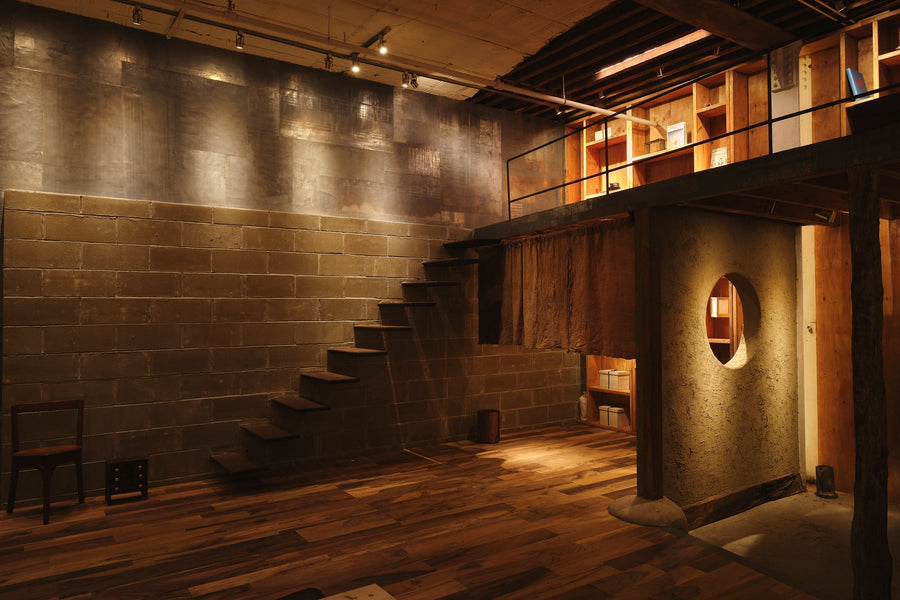
Chowa Hall Tokyo is our first Tokyo project, set on the former estate of Prime Minister Takeo Miki. We were entrusted with transforming his 1970s guard house into a new cultural ground, an honour that strengthens Chowa's commitment to carrying forward the traditions that shaped us while seeking harmony with innovation.
私たちにとって初めての東京でのプロジェクト。三木武夫元内閣総理大臣の旧邸の敷地内にある1970年代の守衛所を、新たな文化の拠点へと生まれ変わらせる役目を託されました。

The actual set was placed inside the show along with the photograph
INSTALLATION

The blossom

The blossom

The blossom

The baobab tree on the wall of Chowa Hall Tokyo

The baobab tree on the wall of Chowa Hall Tokyo

The art works are placed with antique objects that communicate with each other.

Kumbuk Noemi Stool
The works
--------------------------------